






|
Objectives
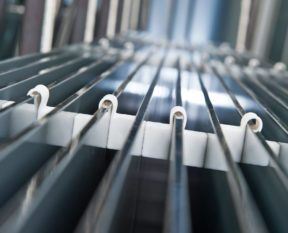
Until now the generally applied aluminium distance frames, an essential element in double glazing, with ever improving window frame and glazing heat conductivity coefficient values were shown to be the weak point in combined pane construction. Aluminium has significantly greater heat conductivity than the remaining window components. The aluminium frame around the edge of the pane is the last route of excessive heat penetration from the room to the exterior. This effect has been taken into account in the new approach to calculation of the coefficient Uw of the window and has been described with coefficient Psi (Ψ). The solution to this problem may be the application of a distance frame - called warm frame*, executed from compound insulation material or fine steel.
Bent corners are a basic requirement
One of the significant criteria taken into consideration in the assessment of combined panes is also their tightness, equally against damp penetration to the interior of the pane, as the loss of gas with which the panes are filled to improve thermal and sound absorbency parameters.
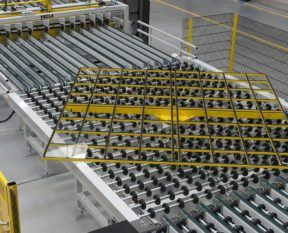
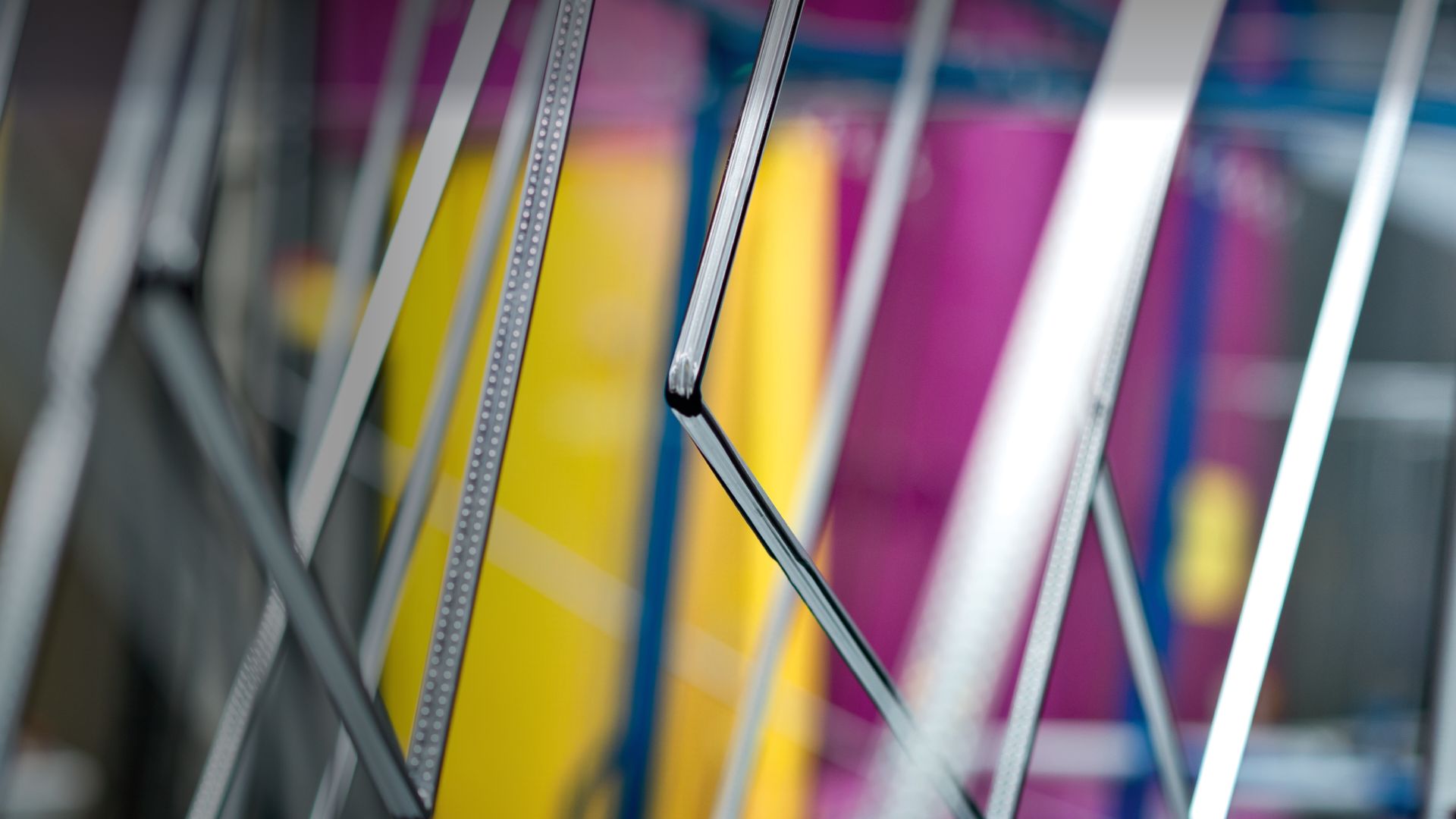
In order to assure the highest parameters, a warm distance frame that is applied in combined panes should not be cut and joined the corners using plastic connectors. Such methods of frame forming have the effect of reducing pane tightness, which may cause the noble gas contained in the space between the panes to escape and in turn the deterioration of heat insulation, which thwarts the purpose of benefiting by applying warm frames. The weak points consisting of corners of combined panes executed from cut frames are eliminated by applying bent frames at the corners, which is one of the basic solutions applied in order to create a product of the highest quality parameters.

Warm frame criterion according to PN-EN ISO 10077-1
To the time of establishing clear criteria enabling the definition of the warm frame concept, many combined distance profile panes were sold on the market, which were indeed warmer than aluminium frames however had incomparably worse properties than correct solutions. According to this frames with improved design standard parameters are those, in which the distance frame fulfils the following inequality:
Σ (diλi) ≤ 0,007 W/K
gdzie:
d i - thickness of partition material
λ i - television of conductivity of material in W/mK
Example :
2(d1λ1) + (d2λ2) ≤ 0,007 W/K 
The table below shows how particular types of frames fulfill the raised criterion:
|
Type of frame |
Value ∑ (di x λi)
EN ISO 10077-1
|
Qualification assessment
of frame as "warm frame"
|
|
Aluminiowa |
0,1120
|
negative
|
|
Thermix TX.N |
0,0019
|
positive
|
|
Termo TGI |
0,0020
|
positive
|
Stainless steel
Chromatech |
0,0052
|
positive
|
Stainless steel
Chromatech Plus |
0,0043
|
positive
|
|
Chromatech Ultra |
0,026
|
positive
|
It should be emphasised that the actual effect of a thermal bridge on the edges of combined panes mounted in windows depends on the type of distance frame, heat insulation of the central part of the combined pane and the depth of the pane seating in profile and the coefficient of heat penetration Uf of profile. Together with the increase in seating depth of the pane the proportion of heat loss of windows through the edge is reduced and minimises the possibility of the occurrence of water vapour.
The table presented below compares the coefficient Psi of the most popular bent corners warm distance frames* on the market with aluminium frames. This data is given on the basis of the IFT Rosenheim WA-08/1 guidelines drawn up on the basis of research conducted in 2008.


|
Construction of pane
|
Type of frame
profile
|
Type of distance spacer frame
|
Wsp. Psi
|
Top-Glas Ug=1,1
4/16/4T Ar |
PVC/Wood |
Aluminium |
0,08 |
Top-Glas Plus Ug=0,7
4T/12/4/12/4T Ar |
PVC/Wood |
Aluminium |
0,08 |
Top-Glas Ug=1,1
4/16/4T Ar |
PVC |
Thermix TX.N |
0,041 |
Top-Glas Plus Ug=0,7
4T/12/4/12/4T Ar |
PVC |
Thermix TX.N |
0,038 |
Top-Glas Ug=1,1
4/16/4T Ar |
PVC |
Termo - TGI |
0,044 |
Top-Glas Plus Ug=0,7
4T/12/4/12/4T Ar |
PVC |
Termo - TGI |
0,041 |
Top-Glas Ug=1,1
4/16/4T Ar |
PVC |
Stainless steel - Chromatech |
0,051 |
Top-Glas Plus Ug=0,7
4T/12/4/12/4T Ar |
PVC |
Stainless steel - Chromatech |
0,048 |
Top-Glas Ug=1,1
4/16/4T Ar |
PVC |
Stainless steel - Chromatech plus |
0,051 |
Top-Glas Plus Ug=0,7
4T/12/4/12/4T Ar |
PVC |
Stainless steel - Chromatech plus |
0,048 |
Top-Glas Ug=1,1
4/16/4T Ar |
PVC |
Chromatech Ultra |
0,041 |
Top-Glas Plus Ug=0,7
4T/12/4/12/4T Ar |
PVC |
Chromatech Ultra |
0,038 |
Top-Glas Ug=1,1
4/16/4T Ar |
Wood |
Thermix TX.N |
0,041 |
Top-Glas Plus Ug=0,7
4T/12/4/12/4T Ar |
Wood |
Thermix TX.N |
0,039 |
|
Top-Glas Ug=1,1
4/16/4T Ar
|
Wood |
Termo - TGI
|
0,044
|
|
Top-Glas Plus Ug=0,7
4T/12/4/12/4T Ar
|
Wood
|
Termo - TGI
|
0,043
|
|
Top-Glas Ug=1,1
4/16/4T Ar
|
Wood
|
Stainless steel - Chromatech |
0,053 |
Top-Glas Plus Ug=0,7
4T/12/4/12/4T Ar |
Wood
|
Stainless steel - Chromatech |
0,053 |
|
Top-Glas Ug=1,1
4/16/4T Ar
|
Wood
|
Stainless steel - Chromatech plus |
0.052 |
Top-Glas Plus Ug=0,7
4T/12/4/12/4T Ar |
Wood
|
Stainless steel - Chromatech plus |
0,052 |
|
Top-Glas Ug=1,1
4/16/4T Ar
|
Wood
|
Chromatech Ultra |
0,041 |
Top-Glas Plus Ug=0,7
4T/12/4/12/4T Ar |
Wood
|
Chromatech Ultra
|
0,040
|
From the table above it is shown that the application of plastic or stainless steel warm frames reduces Psi coefficient to 30% in relation to panes with aluminium frames. The effect of this is an increase of window temperature from the side of the room on the contact of frame with combined pane.
With the effect that permissible relative air moisture, which in given conditions forms water vapour may due to the application of "warm frames" be higher by approx. 10-15% and shall not cause occurrence of water vapour condensation. The permissible external minimal temperature is also reduced, at which water vapour condenses on pane surfaces.
The table below presents an example of temperature breakdown on window surface from room side of various types of distance frame for Top-Glas Ug=1.1 4/16/4T Ar
|
Test conditions |
Type of window frame profile |
Type of distance frame used |
Temperature at edges of internal panes in
combined panes
[°C]
|
Δt the edge and in the middle of combined internal pane
[°K]
|
Moisture dew point at edge of internal pane
[%]
|
|
External temperature
0°C internal temperature
+20°C
|
Wood
|
Plastic
|
13,3
|
4,5
|
64,1
|
|
Stainless steel
|
12,4
|
5,2
|
62,8
|
|
Aluminium
|
10,8
|
6,8
|
55,7
|
|
PCV
|
Plastic
|
13,2
|
4,7
|
64,3
|
|
Stainless steel
|
12,5
|
5,3
|
62,3
|
|
Aluminium
|
11,1
|
6,7
|
56,2
|
Example of calculation of coefficient of heat penetration of window Uw.
Method of calculating coefficient of heat penetration of window Uw, in which the influence of the connection of the frame with the pane is taken into account is indicated in Standard PN-EN ISO 10077 in the form of the following formula:

Uw - coefficient of heat penetration of window [W/m2K]
Af - surface of frame
Uf - coefficient of heat penetration [W/m2K]
Ag - glazed surface w [m2]
Ug - coefficient of heat penetration of pane [W/m2K]
Lg - circumference [m] (edge of glass)
Ψ - Linear heat penetration of window [W/mK]
In order to introduce the above formula we present a calculation example for a single window O32 of dimensions 535 x 1435 mm. The window is executed from the three-cell PCV profile strip of a complete width of frame and window of 125mm.
For calculation the following assumptions are accepted:

Af = 0,43 m2
Uf = 1,2 W/m2K
Ag = 0,3377 m2
Ug = 1,1 W/m2K
Lg = 2,94 m
Ψa = 0,06 W/mK (aluminium frame)
Ψb = 0,041 W/mK (Thermix TX.N)
Ψc = 0,044 W/mK (Termo TGI)
Ψd = 0,051 W/mK (Chromatech)
Ψe = 0,051 W/mK (Chromatech Plus)
Ψf = 0,041 W/mK (Chromatech Ultra)
Window with aluminium frame (a):
Uw,a = 1,39
Window with Thermix TX.N frame (b):
Uw,b = 1,31
Window with Termo TGI frame (c):
Uw,c = 1,32
Window with Chromatech frame (d):
Uw,d = 1,35
Window with Chromatech Plus frame (e):
Uw,e = 1,35
Window with Chromatech Ultra frame (f):
Uw,f = 1,31
The results received indicate that the coefficient Uw of a window with a warm frame is improved correspondingly in relation to a window with an aluminium frame of:
-
6.1% for Thermix TX.N frame and Chromatech Ultra frame
-
5.3% for Termo TGI
-
2.9% for Chromatech Plus frame and Chromatech
Benefits summary
Making the choice of warm distance frames, included in the product range, we are concentrating on:
-
ensuring long-term correct tightness of combined panes due to bend frames at corners,
-
maximising savings of heat energy losses through reduction of thermal bridge connecting frame with pane,
-
limiting the risk of water vapour condensation on edges of panes inside the room,
-
problem free mounting of decorative window dividers.
Range offered
|
Type of frame
|
Colour
|
Widths
|
|
Thermix TX.N |
RAL
grey 7035;
black 9005
|
8, 10, 12, 14, 16, 18, 20 |
|
Termo TGI |
RAL
grey 7035, 7040;
brown 8003, 8016;
black 9005 |
8, 10, 12, 14, 15, 16,
18, 20, 22, 24
|
|
Stainless steel Chromatech |
natural
black 9005
|
8, 10, 12, 14, 15, 16, 18, 20 |
|
Stainless steel Chromatech Plus |
natural |
10, 12, 14, 16, 18, 20 |
|
Chromatech Ultra |
grey RAL 7035;
black 9004
|
16 |
» see colours offered for warm spacerbars
Particular characteristics of frames offered
Distance frames offered by Press-Glas, besides the joint characteristics, depending on the requirements of clients, may be differentiated by other traits:
-
Chromatech Plus and Chromatech frames are typified by higher tightness than plastic frames with stainless steel foil,
-
Among the offered plastic frames Thermix TX.N and Chromatech Ultra has the best heat insulation and the greatest rigidity,
-
steel frames possess the optimal coefficient of linear extension, which amounts to 9x10⁻⁶K-1. For comparison with the coefficient of glass this amounts to 12x10-6K-1. Thus steel and glass possess very similar coefficients of linear extension, which in practice results in minimal stress at the glass-distance frame border, and in consequence minimal frame bulging, caused by heating of combined panes. For example: combined pane of length 200 cm produced in temperature +20 oC been subjected to heating to temperature +80 oC shows the following linear extension:
* glass – 1.08 mm/m;
* stainless steel distance frame – 1.44 mm/m;
* aluminium distance frame – 2.88 mm/m!!!
Whereas between glass and a steel frame the difference in linear extension amounts to 0.36 mm, in the instance of the difference between glass and an aluminium frame, linear extension amounts to 1.8 mm. In connection with this, the application of a steel distance frame has a five times lower stress value at sealing edges of the panes in comparison with an aluminium frame.
|